Posted by JLewis on | Comments Off on Addressing Common Questions About Drywall and Masonry Anchors
While drywall anchors and masonry anchors are generally similar in appearance, they are designed for completely different materials. They also don’t behave the same way under load.
In this post, we provide you with the important details on drywall and masonry anchors so you’ll know the difference between the two and be able to confidently select the right option for your project needs.
Types of Anchors: Drywall vs. Masonry Anchors
Anchors fall into one of several types:
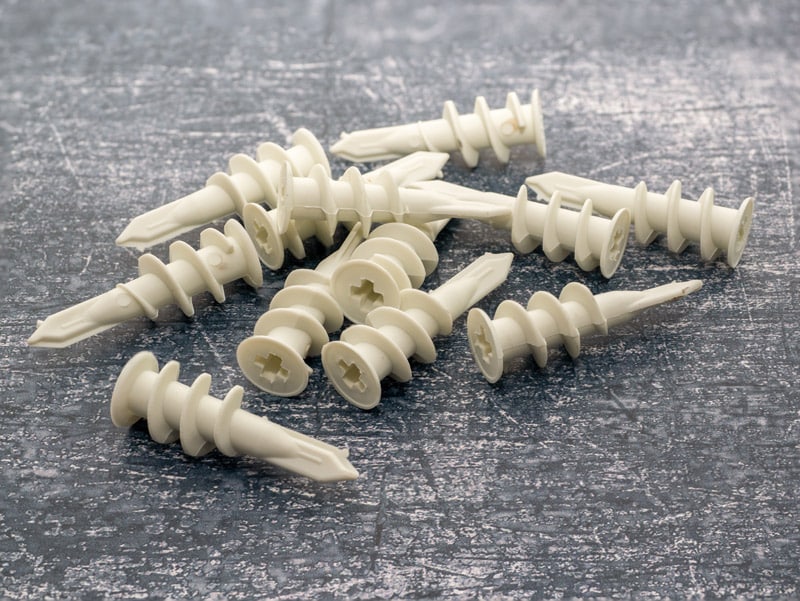
Drywall anchor options “grip” gypsum board, or hollow wall material, by expanding, threading, or clamping behind the wall surface.
Masonry anchors are built for solid materials like concrete, block, or brick. They grip by expanding, wedging in place, or grabbing the material with threads.
Deciding between the two anchor types will depend on the base material. It’s also important to consider the load and environment for optimal results.
Masonry Anchors
Masonry anchors are useful when fastening to CMU (block), concrete, or brick. They will often be specified by anchor type and base material.
Masonry anchors are commonly used for:
Mounting equipment, pipe supports, racking, or guardrails to concrete
Attaching fixtures to block walls (with the right anchor style for hollow versus solid block)
Fastening to brick (only when the job and wall are a good fit)
Heavy Duty Dry Wall Anchors
When you need something stronger than a basic plastic expansion anchor, heavy-duty dry-wall anchors are a reliable choice. These can include:
Toggle-style anchors (spring toggles or strap toggles) that clamp behind the drywall
Molly bolts (hollow-wall anchors) that expand behind the wall when tightened
Heavy-duty self-drilling drywall anchors that thread into drywall (best for light-to-medium loads)
How to Use Drywall Anchors
The way you use drywall anchors depends on the anchor style. Most installs will follow this general process:
Determine the wall type and thickness first. Most drywall is 1/2″ or 5/8″, and the anchor package will tell you what thickness it fits.
Mark the spot and check for anything behind the wall, avoiding wiring and plumbing whenever possible.
Drill a pilot hole if required. Some anchors are self-drilling, while others need a specific hole size.
Push-in, tap-in, thread-in, or insert toggle hardware per the anchor type.
It’s important to test the anchor before full loading, especially for anything overhead or safety-related.
Which Anchor Should I Use for Drywall?
The following are potentially useful options for drywall anchors:
Plastic expansion anchors. Best for light items like photographs, towel bars, and signage.
Self-drilling threaded anchors. Common with medium-weight applications like shelves and light fixtures.
Toggle bolts. Suitable for heavier items like large TVs and cabinets.
Do I Need a Special Drill Bit for Anchors?
A standard twist bit in the specified size works for many drywall anchors. You’ll usually need a masonry bit (carbide-tipped) and sometimes a hammer drill for masonry anchors, especially in concrete.
Additional Questions and Considerations
Consider the following questions and variables that can make the difference when installing anchors.
What’s the biggest mistake people make?
Don’t use a drywall anchor in masonry or vice versa. A drywall anchor isn’t made to grip solid concrete, and masonry anchors won’t expand correctly in hollow drywall.
Can I use masonry anchors in brick?
Yes, if you choose the right type for brick and factor in the condition of the material. Brick and mortar can crack if the wrong anchor is over-torqued.
What about corrosion resistance?
If the area is humid, outdoors, or near chemicals, choose a stainless steel or a protective coating that fits the environment and any other needs.
Contact Associated Fastening Products, Inc. to Learn More
Choosing between drywall and masonry anchors involves a few important steps: know what you’re fastening into, pick an anchor that fits the weight and the environment, and install and test it for the intended application. A little homework up front can help you avoid callbacks, prevent wall damage, and keep everything safe and reliable.
Need help selecting the right drywall anchor, heavy-duty drywall anchors, or masonry anchor bolts for your project? Do you want to standardize anchor options across your maintenance kits? Associated Fastening is here to help.
Posted by JLewis on | Comments Off on How Associated Fastening’s KEYENCE Machine Improves Fasteners
At Associated Fastening Products, Inc., we understand the ramifications for our clients of using an inaccurate or suboptimal fastener. That’s why we rely on the KEYENCE Image Dimension Measurement (IM) System to take our fastener production and quality control to the next level. This efficient and versatile system features multiple industry-first innovations that speed up the fastener measuring process with precision, streamlining procedures and cutting down on setup time. Learn more about this unique machine and how our experts are using it to increase the quality of your fasteners.
KEYENCE for Fasteners
For die-cast, machined, and pressed components, tooling, springs, gears, and much more, we supply our customers with such fastener types as:
Bolts
Bushings
Connectors
Pins
Screws
For any of these fasteners to sufficiently do their job, their dimensions must be exact to properly fit into the intended components and create durable joints or assemblies. Getting the details right and factoring in such critical considerations as proper fastener design, dimensional tolerances, pitch profile, and thread gauge is crucial to guaranteeing everything holds together securely.
The KEYENCE machine’s accuracy, as well as its ability to store and report fastener specifications to assist in future orders, are among the many reasons Associated Fastening Products chose the KEYENCE system for our business. Easy to operate, this system utilizes a specialized lens with auto-focus capabilities and a wide field of vision. The machine scans the surface of a fastener in its entirety in as little as one second, taking automated measurements of thread pitch, head shape, or other required parameters. The VR Series also allows us to measure a higher number of samples, reducing processing times.
Benefits of the KEYENCE Machine
Our KEYENCE Optical Measuring Machine allows our customers to capitalize on a range of benefits.
Exacting Dimensional Precision
The KEYENCE machine imbues our fastener production services with exceptional precision. With its advanced software and optics technology, it measures fasteners with pinpoint accuracy, helping us manufacture tight-tolerance fasteners that meet your dimensional specifications. This level of precision is critical in industries like aerospace, automotive, and medical, where even minor variations can lead to equipment failure and safety issues.
Improved Adherence to Quality Standards
Using our KEYENCE machine, we can catch even the tiniest issues in a fastener, helping us to achieve the highest level of quality in our operations and products with heightened quality control. It’s also beneficial for evaluating prototypes and performing shipment inspections. By spotting potential problems as early as possible, we help our customers avoid equipment breakdowns and costly unscheduled downtime. The automated measuring process takes human error out of the equation, so we know each batch is consistent and reliable.
Efficiency Through Enhanced Operational Speeds
Operational speed matters in manufacturing and bringing your product to market. The KEYENCE machine significantly reduces measurement time from hours to mere minutes — all without sacrificing accuracy. We’re able to handle orders more efficiently, cut turn times, and most importantly, keep our clients happy. Also, our inspection operators can now function as production operators to boost productivity along with output.
Additional Opportunities for Customization
One of the best things about the KEYENCE machine is its versatility. We can measure fasteners of all shapes and sizes, be they standard or custom, and ensure they meet your application’s tolerance requirements. This makes it simple for us to handle custom orders, accurately measuring and delivering fasteners perfectly tailored to your needs. We can even reverse-engineer your existing fasteners, producing a 1:1 copy of them with highly accurate results.
At Associated Fastening Products, we use the KEYENCE Model IM 7000 to ensure top-notch precision measurement and quality in every fastener order. As a significant enhancement to traditional measuring processes, this system allows us to:
Evaluate as many as 99 dimensions in just 3 seconds
Take precise, repeatable measurements without risking inaccuracies or human error
Manufacture myriad tight-tolerance fasteners for a diverse client base
Identify any fastener variations or production trends, rectifying as needed
Eliminate bottlenecks that used to occur with older and slower fastener measurement methods
Reduce lead times with batch measurement capabilities
Access and review fastener measurements stored in the database at a later date
Receive easily readable reports and data spreadsheets to assist with repeat orders, troubleshooting, or any quality inquiries
Track any wear that our tooling is experiencing
Whether you need one part measured or are looking to ensure consistent quality across a larger production run, our KEYENCE system lets us exceed your expectations. With more productivity, better quality control, and flexible customization, we’ll confirm your fasteners meet your dimensional and tolerance requirements so that you receive exactly what you need, every time.
Contact us to discover how our team and the advanced technology we use can support your next project, or request a quote today to get started.
Posted by JLewis on | Comments Off on What is Thread Engagement?
Selecting the best fastener for an application has a major effect on its functionality and operational lifetime. This includes things like intended use, material, operational environment, and more.
In the case of bolts and screws, another critical consideration is thread engagement. This is the extent to which two threaded components, such as a bolt and nut, interconnect or overlap when the fastener is installed, usually expressed as the length or percentage of engagement.
Keep reading to learn how calculating and choosing fasteners with optimal thread engagement adds significantly to joint and application integrity.
How to Calculate Minimum Thread Engagement
Click to Enlarge
When designing a joint that uses threaded fasteners like bolts and nuts, it’s important to determine the minimum amount of engagement, or overlap, that is needed to ensure a strong joint without stripping threads or damaging components.
Thread engagement is expressed in two ways:
Length of Thread Engagement. This refers to the actual length of the threaded section of a bolt that will be inside the nut when fully screwed in. For example, a bolt with 1.00 in. of threads and a nut with 0.5 in. of threads will have 0.5 in. of engagement when fully screwed together.
Percentage of Thread Engagement. This is the size of the nut or mating hole vs. that of the fastener and the proportion of the height of the bolt’s threads that are engaged.
In calculating the minimum thread engagement required for a specific joint, the goal is to ensure the fastener will be the failure point rather than the nut or component. To do this, it’s necessary to calculate the tensile stress area and shear area on the bolt in the cross-section where the bolt and nut overlap. The tensile stress area is the physical area that provides strength under tension applied to the bolt. The shear area is the physical area of the bolt that resists shearing forces applied to it. These two calculations include factors of major diameter, minor diameter, and pitch diameter.
The ideal minimal length of engagement will use as much of the bolt’s tensile strength as possible before thread shearing occurs. This generally means that the bolt will fail or break instead of the nut or other internally threaded component being stripped. If the fastener and nut are made of materials with different properties and tensile strengths, this affects how the length of engagement is calculated.
Some rules of thumb are helpful when making these calculations for certain materials, such as:
For aluminum threads, the minimum thread engagement should be 2.0 to 2.5 x the bolt’s or screw’s base nominal diameter
For brass or cast iron threads, the minimum thread engagement should be 1.5 to 2.0 x the bolt’s or screw’s base nominal diameter
For steel threads, the minimum thread engagement should be 1.0 to 1.5 x the bolt’s or screw’s base nominal diameter
Why Is Thread Engagement Important?
Thread engagement is a way to add to the strength and durability of a joint, which in turn improves the functionality and useful life of the application. The key is to strike a balance between the ideal bolt length and depth of the bolt in the nut member, as this will prevent breakage and stripping.
If thread engagement is inadequate, threads in the nut or tapped component may be stripped due to high stress and shear forces. The joint also may not be strong enough to withstand other stresses from opening and closing, vibrations, or other use conditions.
Greater thread engagement length generally increases the tensile strength of the joint; however, specifying a bolt that is too long or has a length of engagement that is excessive may result in additional cost or wasted material. A very high length of engagement can also cause high levels of torque for driving in the bolt or screw, which can compromise strength or cause the fastener to break during assembly or installation.
Source Standard and Customer Fasteners from Associated Fastening
Thread engagement is critical in designing a strong joint that will resist shearing and failure over an application’s lifetime. Associated Fastening Products, Inc. provides a comprehensive selection of fasteners, cable ties, hardware kits, O-rings, washers, and fittings. We also offer CNC and Swiss screw machining, water jet and laser cutting, and metal stamping services.